
Investor wealth on Thursday soared by Rs 1 lakh crore, triggered by heavy buying in the stock market, with the BSE benchmark Sensex surging about 382 points to close at near six-week high levels.

Investors globally pulled out more than $3 billion from equity funds focused on Emerging markets including India in a week amid concerns over the US Federal Reserve's plan of curtailing its stimulus drive starting later this year.

NITI is trying to partner with other knowledge institutions.

The central government is on track to meet its fiscal deficit target of 6.4 per cent of the GDP for 2022-23 on the back of strong growth in revenue collections, the World Bank said in its India Development Update on Tuesday. High nominal GDP growth in the first quarter supported strong growth in revenue collection, especially Goods and Services Tax (GST), despite tax cuts on fuel. Notwithstanding an increase in spending due to expanded fertilizer subsidies and food subsidies for vulnerable households in response to the commodity price shock, the government is on track to meet its FY22/23 fiscal deficit target of 6.4 per cent of GDP and the general government deficit is projected to decline to 9.6 per cent from 10.3 per cent in FY21/22 and 13.3 per cent in FY20/21.

Images from Day 2 of the Wimbledon tennis championships in London, on Tuesday.

The 30-share Sensex ended at 25,706 down 151 points.
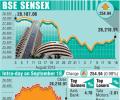
The 30-share Sensex ended up 255 points at 26,219.

Nine of the top-10 most valued companies together lost a whopping Rs 309,178.44 crore in market valuation last week as selloffs continued. In a holiday-shortened past week, the 30-share BSE Sensex plummeted 1,836.95 points or 3.11 per cent amid geopolitical tensions, global sell-off triggered by a hawkish US Federal Reserve and unabated foreign fund outflows. From the top-10 list, State Bank of India was the lone gainer as its valuation jumped Rs 18,340.07 crore to reach Rs 467,069.54 crore.

Bharti Airtel was the top gainer in the Sensex pack, rallying over 4 per cent, followed by Axis Bank, Tata Steel, Titan, Maruti and Bajaj Finance. NSE Nifty surged 225.85 points to its record closing of 16,931.05.

Benchmark indices failed to hold on to early gains and closed in the red for the seventh straight session on Thursday, with participants remaining in wait-and-watch mode ahead of the RBI's interest rate decision. Unabated selling by foreign funds added to the pressure, though a modest recovery in the rupee cushioned the fall, traders said. After rallying in early trade, the 30-share BSE Sensex came under selling pressure in the afternoon session and closed 188.32 points or 0.33 per cent lower at 56,409.96.

Despite markets turning volatile, share sale activity at India Inc has surged to its highest level in five months. So far in March, promoters, strategic investors and other large shareholders have been able to offload shares worth more than Rs 33,000 crore-the most since November-defying uncertain market conditions. Both the Sensex and the Nifty are on course to post their fourth straight monthly loss amid headwinds, such as interest rate tightening by the US Federal Reserve and the global banking crisis.

'We are not entirely out of the woods.' 'The broader trajectory remains tentative.' 'However, we may expect some near-term bounce.'
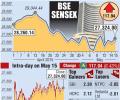
The 30-share Sensex gained 118 points to end at 27,394.

Benchmark stock indices opened the week on a muted note on Monday, with the Sensex plunging nearly 483 points due to selling in IT, capital goods and banking shares amid losses in global equities. The Sensex tanked 482.61 points or 0.81 per cent to settle at 58,964.57. During the day, it tumbled 552.78 points or 0.92 per cent to 58,894.40. The 50-issue Nifty declined by 109.40 points or 0.62 per cent to finish at 17,674.95 as 29 of its stocks declined.


FPIs have turned net sellers in 2022 after being net buyers in the last three years.

Historically, March has been a volatile month for Indian equity markets. To begin with, it marks the end of a financial year, wherein there is some compulsive portfolio rebalancing trade by large funds - domestic and foreign. Retail investors, too, prefer to 'cash in' on their gains and losses before the financial year runs out.

The market capitalisation of BSE-listed companies reached an all-time high of Rs 261.73 lakh crore on Thursday, helped by a massive rally in the equities where the benchmark Sensex zoomed 958 points to end at a fresh lifetime peak. The 30-share BSE benchmark jumped 958.03 points or 1.63 per cent to settle at its new closing peak of 59,885.36. During the day, it gained 1,029.92 points to touch an intra-day record high of 59,957.25.

After a spirited eight-hour debate in which 60 members participated, the Lok Sabha passed the Constitution (128th Amendment) Bill, with 454 members voting in favour and two against it.

Tech Mahindra, the top loser in the Sensex pack, shed over 2.5 per cent. It was followed by UltraTech Cement, Reliance Industries, HCL Tech, HDFC, Kotak Bank, HDFC Bank and TCS. NSE Nifty plunged 179.35 points to 17,745.90.

If the concerns over risking political capital are overcome, the long-term gains for the Indian economy will be immense, asserts A K Bhattacharya.
US Federal Reserve Chairman Ben S Bernanke held talks with RBI Governor Duvvuri Subbarao in Mumbai.

An escalation in the already simmering tensions between North and South Korea, China and Taiwan, and Russia and Ukraine could prove to be a bigger worry for the markets over the next few months rather than central bank policy action, said analysts. The markets, they said, are still not fully factoring in this possibility. "The conflict between Iran and Saudi Arabia is another geopolitical worry.

Bajaj Finserv was the top gainer in the Sensex pack, rising over 4 per cent, followed by L&T, HDFC, Axis Bank, SBI, Reliance Industries and IndusInd Bank. NSE Nifty soared 276.30 points to its new closing peak of 17,823.

Other officers had to escape from the place without conducting the search to save their lives as the mob became "very violent" and even chased the officials so as to deter them from performing their official duty, it said.

Reflecting nervousness over the prospect of the Federal Reserve tightening policy and event risk, traders stayed on the sidelines

Domestic equities will be mainly driven by global market trends, foreign institutional investors' movement and developments around new Covid variant Omicron this week, according to analysts. Markets traded under pressure last week following weak global cues and overall investor sentiment remained downbeat throughout the week, they observed. "Global markets, Omicron variant, dollar index and FIIs' behaviour will be key factors to drive the market this week," said Santosh Meena, head of research, Swastika Investmart Ltd. One major event last week was US Federal Reserve's announcement that it will end bond-buying from March, and it also signalled starting rate hike cycle thereafter.

The S&P BSE Sensex gained 57 points to end at 26,064.

The 50-share NSE Nifty too rose by 20.35 points, or 0.19 per cent, to end at 10,908.70.

A sharp rally in domestic stocks from June lows has once again rendered Indian markets expensive to their emerging-market (EM) peers. The 12-month forward price-to-earnings (P/E) multiple for the Nifty50 Index is around 20.6x - 82 per cent higher than 11.3 per cent for the MSCI EM Index. India's valuation premium has hit a five-month high. This is on the back of sharp outperformance to EM and global peers from June lows and also due to earnings downgrades, following the April-June quarter of 2022-23 earnings.

'India is an equity market with a breadth and depth of companies to invest in.'

Bajaj Finance was the top gainer in the Sensex pack, soaring around 8 per cent, followed by IndusInd Bank, Bajaj Finserv, ICICI Bank, Kotak Bank, SBI, Bajaj Auto and HDFC Bank. NSE Nifty surged 211.50 points to 14,864.55.
The impact of the Iraqi war on the US economy cannot be gauged until enough critical data relating to the period since the war's onset is available over the next several weeks, Federal Reserve policymakers said on Monday.
Emerging markets like India and China are witnessing a remarkable transformation, despite a slowdown in economic growth, lifting millions of people out of poverty, Federal Reserve Chairman Ben Bernanke has said.

The re-opening of the Chinese economy, as it moves away from its zero-Covid policy, could help stabilise commodity prices, according to some of the country's top metal companies. They view this as a positive for demand, at a time when markets such as the US and Europe have been largely weighed down by slowdown concern now. "Most of us in the metals business are hoping the Chinese economy picks up because half of any metal demand, including demand for aluminium, comes from China.

Amid volatility in stock markets generated by tension between Russia and the US over Ukraine, LIC chairman M R Kumar on Monday said that the insurance behemoth was watching the geo-political situation carefully, though it was keen on listing of the IPO in March. The Life Insurance Corporation (LIC) has already filed the DRHP with the Securities and Exchange Board of India (SEBI) for its initial public offering (IPO). "We are watching the situation closely and carefully...but we are very keen on having listing in March," Kumar said, when asked about the impact of the evolving geopolitical situation on the upcoming IPO.

'An eerie similarity with 2019 inflation trajectory could now mean that the RBI and market inflation estimates could go awry.'

Top gainers in the Sensex pack included Infosys, Bajaj Finance, Maruti, HUL, HCL Tech and Reliance Industries, while M&M, IndusInd Bank, ITC, PowerGrid and L&T were among the losers. The NSE Nifty settled 190.80 points, or 2.51 per cent, down at 7,801.05.

If there was one event that made the month of August stand out, it was a strengthening of the dollar index to levels last seen only 20 years ago, as the Federal Reserve dispelled all doubts about its intention to continue raising interest rates. Predictably, most currencies suffered against the US unit, with the bulk of the losers belonging to the emerging markets pack. Amid the volatility, the rupee, however, has displayed significant resilience and fared much better than most of its peer currencies.
